Imagine you are a bank teller. Someone comes in and tries to withdraw money from their bank account but there aren’t enough funds for the transaction. They do it anyway, resulting in their account going into the red. They may be penalized with overdraft fees or need to take out a loan with interest to pay for the transaction. Well, this is a great analogy for understanding what happens to our bodies when we don’t have enough energy (or money) to pay for our day-to-day activities.
What is Relative Energy Deficiency in Sports (REDs)?
Food is our bodies currency for performing daily tasks, physical activity, and supporting body functions like breathing or blinking. Relative Energy Deficiency in Sport (REDs) occurs when there is not enough energy (or money) coming in to support the demands of both physical activity and essential body functions. Another name for this is low energy availability (LEA). Without enough energy, the body will adapt by trying to “spend” as little energy as possible. Just like we might prioritize paying for certain bills when on a budget, our body will allocate energy to the most important body functions while sacrificing energy for non-essential bodily processes. This causes our bodies to go into the red, creating a cascade of negative health and performance consequences.
REDs is an expansion of the ‘Female Athlete Triad’ that emerged in the 1990’s to explore the physiological adaptations to the female body from exercise.
Researchers realized low energy availability had many more impacts on the body than originally thought and it was not just independent to females – it can occur in males, too.
Who Is at Risk for REDs?
REDs can occur at any body size, shape, or weight. However, there are certain people who may be at a higher risk:
- Highly active people pursing weight loss or body composition changes
- Those with history of or are currently dieting, have disordered eating, or an eating disorder
- Changes in exercise volume/ intensity without modifying nutrition
- Sports with more emphasis on weight/ appearance (wrestling, gymnastics, dance, running, equestrian, …), gravitational sports (climbing, ski jumping), and endurance athletes
- Recreational athletes training like elites – High volume + busy life = chronic under fueling
- Adolescents – growing bodies need more energy!
- Athletes with perfectionistic tendencies or rigid patterns
- Those in a high-stress training culture or body-focused coaching environment
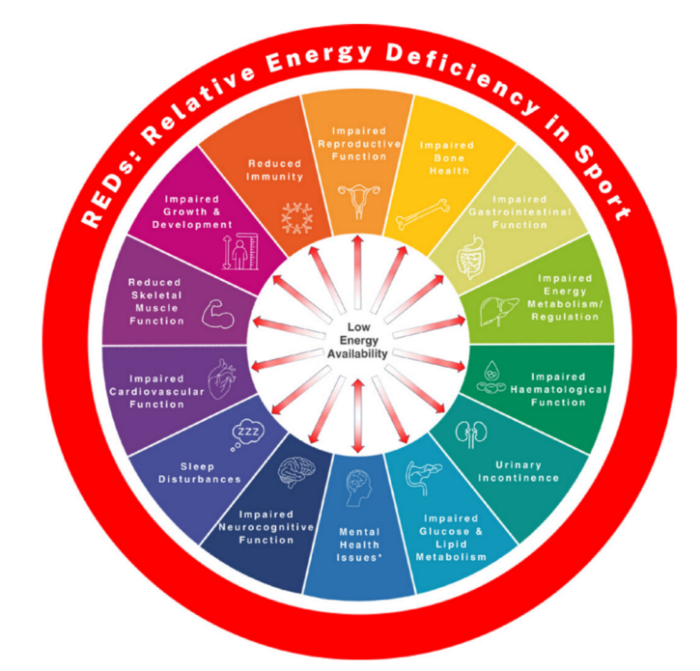
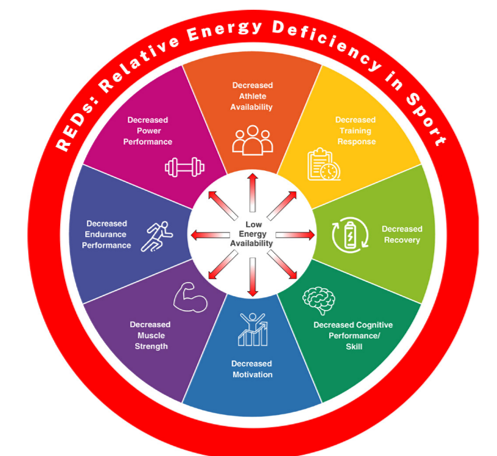
Source: Mountjoy M, Ackerman KE, Bailey DM, et al. 2023 International Olympic Committee’s (IOC) consensus statement on Relative Energy Deficiency in Sport (REDs). Br J Sports Med. 2023;57(17):1073-1097. doi:10.1136/bjsports-2023-106994
REDs conceptual models from the International Olympic Committee’s Consensus Statement. Low Energy Availability (LEA) is the ‘exposure’ that leads to the health and performance outcomes around it. These outcomes occur at different severities and over different periods of time. It exists on a continuum, where some LEA may have mild impacts and the body adapts, problematic LEA is associated with a variety of adverse health outcomes.
What are the Warning Signs and Symptoms of REDs?
- Mood changes
- Anxiety, depression
- Feeling shaky, dizzy, or lightheaded
- Hot flashes
- Feeling weak, low energy
- GI distress or stomach pain (at rest and during training)
- Frequent illness
- Abnormal labs (examples: cholesterol, thyroid, and sex hormones)
- Amenorrhea in females
- Low libido
- Bone fractures/ injuries
- Trouble sleeping
- Dry and/or brittle hair, skin, nails
- Body weight changes (weight loss or weight gain with calorie restriction)
- Changes in social interactions, isolation from team or friends
- Decreased concentration, memory, energy, muscle function, coordination, speed
- Increased fatigue and perceived exertion
- Prolonged recovery times
- Decreased adaptation to training
- Anxiety with days off, recovering, off season, and tapering
- Preoccupation with food (self and others)
- Disordered eating
- Body dysmorphia, body image distress, overly concerned with aesthetics/ appearance
It is important to note that some performance improvements might be seen in the beginning due to the body adapting to short term LEA (such as initial increase in oxygen uptake or initial increases in cortisol/adrenaline/noradrenaline). The body hyper-responds at first, but this is temporary if things don’t change.
Ways to Prevent REDs
- Work with a dietitian to learn how to properly fuel your body
- Take rest days
- Practice flexibility and challenge rules/ rigidity around exercise
- Remind yourself that health and performance do not have a ‘look’
- Shift your focus from body weight/shape to performance goals or the way exercise makes you feel
- Attend regular check-ups with your doctor to monitor labs
I Think I Might Have REDs, What Now?
If you are concerned you may be experiencing REDs, it’s important to see a sports medicine doctor for further exploration into what is going on. Your doctor may want to do additional testing and refer you to a therapist and dietitian to gather more information about your concerns to determine if it is an appropriate diagnosis.
It is normal for recovery from REDs to take some time. Remember, your body may have had to take out a loan to support body functions so there might be accrued interest to pay back. It is absolutely possible to recover from REDs!
To schedule with an appointment with one of our dietitians specializing in sports nutrition and REDs, call today at 984.263.4029, or schedule on MyChart.